Traditional healing is close to being covered by Medicaid in Arizona

GANADO — The 9-year-old boy was hurting himself, running into walls and banging his head into them. He was directed by a spirit voice who told him to do it, Harrison Jim said, recalling the patient.
Jim, hired last year as the sole traditional healer on staff at Sage Memorial Hospital on the Navajo Nation, listened.
Sage Memorial is in Ganado, about 144 miles northeast of Flagstaff and the hospital is operated by the nonprofit Navajo Health Foundation. The hospital absorbs the cost of Jim’s salary without any funding from insurance, but that could soon change.
A recent decision by the federal government to reimburse tribal providers for some traditional healing through state Medicaid programs in California, Oregon, New Mexico and Arizona means Sage Memorial in 2025 could begin receiving money for the sacred Navajo traditional healing services that Jim has been growing at the hospital since June.
Jim recalled asking the boy and his mother about past trauma in the boy’s life, and considered the prayers, songs and rituals the boy would need to be whole again. Often, Jim says, traumas involve the past loss of a loved one, or an accident with lasting damage.
“In our culture, these symptoms have a root of what caused these illnesses in a person,” Jim said. “The elders, they say the mind is stuck where the trauma took place.”
Ceremonies can take people “all the way back to the time of the trauma” and then, through prayers and songs, “leave the trauma behind,” he explained.
US ‘Code of Indian Offenses’ marginalized traditional practices
The Medicaid reimbursements in Arizona are expected to allow Jim’s program at Sage Memorial to further expand, perhaps to include more than one traditional provider, hospital leaders say, though advocates of traditional healing hope it’s just a beginning. They’d like private insurers and the federal government’s Medicare program to start reimbursing for traditional healing, too.
The reimbursements won’t happen right away because in Arizona the measure will still need to be greenlighted by the state Legislature, a step that is not required in any of the other three states that got reimbursement approval from the federal Centers for Medicare & Medicaid Services, known as CMS. But the reimbursements have not yet begun in those states, either, as Medicaid and tribal leaders are still working on guidelines.

The recognition has been a long time coming, said Dr. Donald Warne, who is co-director of the Johns Hopkins Center for Indigenous Health and is also the former health policy research director for Inter-Tribal Council of Arizona. Efforts to get sustainable funding for traditional healing have been going on in Arizona for at least two decades, he said.
“One of our big challenges in medicine is that we tend to take a one-size-fits-all approach even though we know there are cultural differences and different practices that are more effective for some populations,” said Warne, who is a member of the Oglala Lakota Tribe in Pine Ridge, S.D.
He noted that for nearly a century, the 1883 federal “Code of Indian Offenses” criminalized traditional medicine and Indigenous cultural practices by creating courts that prosecuted Indigenous people who sought health help from medicine men and medicine women. The law was racist, had the long-term effect of marginalizing traditional rites and healing, and was not fully reversed until the 1978 American Indian Religious Freedom Act was passed, Warne said.
“There is a lack of understanding and a lack of respect for traditional Indigenous medicine and other forms of what we call alternative medicine,” Warne said. “I think one of the things the modern medical system is suffering from is arrogance and a one-size-fits-all approach. So I think modern medicine has a lot to learn from integrative medicine.”

Arizona reimbursements still need OK from the state Legislature
California’s Medi-Cal program expects to release final policy guidance on the reimbursements by the end of February following a public comment period that was scheduled to end Jan. 29, a spokesperson wrote in an email. The New Mexico Medicaid program’s Turquoise Care likely will not start reimbursing for traditional healing at least until the summer, spokesperson Heidi Capriotti said. Officials with the Oregon Health Authority say they are still getting the necessary internal processes in place for the reimbursements to start.
In Arizona, the measure is expected to go through the Legislature this session. As of Jan. 30, no bill had been introduced, but supporters are hoping for bipartisan legislation. Arizona Gov. Katie Hobbs’ executive budget includes $1.3 million in state funding for the program. Though the vast majority of funding will come from the federal government, which has a 100% matching rate for Indigenous people, some state funding may be needed for non-Native people who qualify for services at or through tribal facilities, Arizona Medicaid officials said.
Arizona’s Medicaid program is called the Arizona Health Care Cost Containment System, or AHCCCS (pronounced “access”). It is a government health insurance program primarily for low-income people that covers nearly 80 million Americans, including two million Arizonans.
The traditional healing program will be specific to patients covered by AHCCCS who receive care from traditional healers through Indian Health Service centers, tribally operated health centers or certain Urban Indian Organizations, AHCCCS officials say.

Indigenous have lowest life expectancy of all US groups
Providing coverage for traditional healing will bring cost savings to tribal health providers and better health outcomes for American Indian patients by focusing on wellness, not just treating diseases as they occur, Warne predicted.
The first four states approved for the program will be important for proof of concept, for showing that traditional healing is clinically effective and cost-effective, too, Warne said.
American Indians and Alaska Natives have significant health disparities when compared with the general population. Among other things, they have the lowest life expectancy at birth among all racial and ethnic groups in the U.S., the U.S. Department of Health and Human Services’ Office of Minority Health says.
“We can absolutely have an impact on disparities by incorporating traditional medicine,” Warne said. “We have some programs that provide traditional healing but in a very limited capacity, or sometimes there will be a grant-funded program that allows for traditional services. … The way to make it sustainable is that ongoing reimbursement.”
The reimbursements will allow providers to bolster existing traditional healing programs and to create new, culturally relevant services, he said.
“It’s really a big deal, especially for behavioral health programs,” Warne said. “We have a lot of, for example addiction and recovery programs. What we see is when they incorporate traditional healing services they are more effective. But in those cases, sometimes we expect our traditional healers to volunteer their time and skills because we are not generating revenue.”
Sage Memorial’s Ganado campus dates back to the early 1900s when Presbyterian missionaries began work there and raised money, including a major donation from the Russell Sage Foundation, to open a hospital that opened in 1930. A new, $177 million updated 25-bed hospital opened on the campus in August and serves a rural area of about 12,000 Navajo people. Members of the Navajo Nation are often also known as Diné.
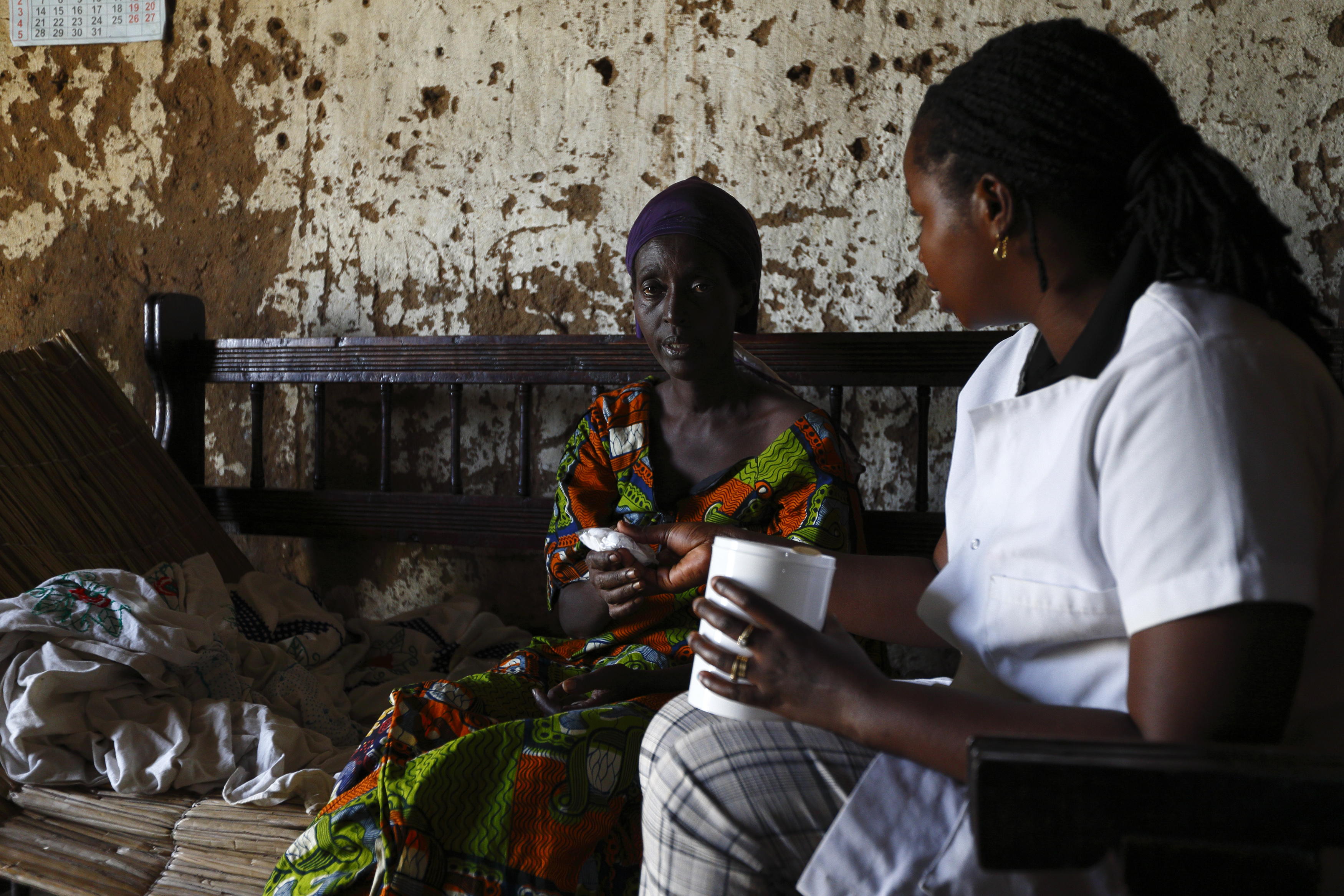
The hospital added Jim to the staff as a way of incorporating what patients had long been requesting and often seeking out on their own — Diné prayers, ceremonies like sweat lodges, talking circles and smudging, and traditional healers who can oversee those rites. The traditional healing accompanies evidence-based Western treatment and does not replace it, said Dr. Richard Laughter, a Diné psychiatrist and director of behavioral health at Sage Memorial.

“Traditional counselors, they will do their role, but they cannot interfere with the medications … That is very important to distinguish,” Laughter said.
“We’re here to help one another, to work together, not to work against one another,” Jim said.
Sage Memorial Hospital leaders say getting reimbursed for traditional healing for Medicaid patients is a positive start, particularly since the program covers close to two-thirds of the health system’s patients.
About 30% of Sage Memorial’s patients are covered by Medicare, which is a government insurance program that primarily covers people who are over the age of 65 and about 5% of the hospital’s patients are covered by private insurance.
Traditional programs helpful with addiction issues, providers say
Some providers say the financial support for traditional health care will spur the development of more tribal programs to help members heal from substance use disorder — a problem that was at the root of a recent crisis with sober living in the Valley that victimized Indigenous people, luring them from reservations with the false promise of free rehabilitation.
One of the biggest problems for Indigenous Arizonans who are dependent on drugs and alcohol is that there are very few programs in remote tribal areas like the Navajo Nation that can help them, Sage Memorial CEO Melinda White said. The Navajo Nation sits on land that’s roughly the size of West Virginia in northern Arizona, as well as in parts of Utah and New Mexico. It has one of the largest memberships of any U.S. tribe. A lack of treatment on tribal lands made Indigenous people vulnerable to predatory treatment providers in the Valley.

Sage Memorial recently set up its own intensive outpatient treatment program for Navajo people struggling with alcohol and drug dependence. The program incorporates traditional healing, and is so popular that the hospital would like it to grow, including offering a place for people to live while they are in treatment.
“When you incorporate that (traditional healing) into a substance abuse program, the healing can happen,” said White, who began her career as a registered nurse. “That’s part of the sweat lodge. There’s been a lot of recovery for people who take the route of going to sweat lodges, sweat houses. … Right now everyone is being referred to the Valley and there’s not enough available on Navajo.”
While medical doctors focus on what’s physical and objective, traditional healing is about addressing a person’s “spiritual realm” and “wellbeing,” Laughter said.
“The spiritual part does help with depression, trauma, anxiety, substance abuse, because you add another element to it. Those don’t have to be chronic problems,” he said.
‘Sober living’ inquiry:Behavioral health providers claim discrimination in ‘sober living’ fraud probe
‘You have a purpose of life, even though you have all these obstacles’
The AHCCCS application for the reimbursement waiver says that since some of the healing practices may be considered religious, they should also always be optional. And indeed, in his experience, only about 20% of Indigenous patients want traditional healing, Laughter said.
The young boy Jim met with said the voice of another boy was telling him to hurt himself. Physical health is sensitive to spiritual and mental influences, and Jim said he’s able to diagnose by listening.
“It’s an unexplained gift one will receive from the deities, to be able to diagnose symptoms,” he said. “It automatically forms in your mind.”
Jim asked the boy’s mother about prior pregnancies and she told him she’d had two miscarriages before the boy was born. Jim referred the family to participate in a Navajo rite known as a blackening ceremony.
“The womb is still haunted,” Jim said. “The energy of the deceased one will reflect on the child. That is what he was seeing and hearing.”
A ceremony will address the energy and spirits and replace any bad energy with balance and harmony, Jim said.
Jim sends patients to traditional healers in the community, since the hospital program at the moment does not have the capacity to offer many lengthy ceremonies aside from sweat lodges.
“Western medicine does not have an understanding of this approach,” Jim said of his work. “We are cleansing individuals of feelings and energy that is harassing and manipulating their mind.”
Each tribe has its own form of traditional health, but Navajo ceremonies focus on family and community, which Laughter said provides hope, direction and its own form of healing.
“I live in both worlds. I am a doctor. I believe in the Western medicine, but I also believe in traditional medicine from my own experience and what I have seen in ceremonies,” Laughter said. “A lot of the time, the existential is what is going to answer the question. … You go through the ritual. You feel clarity. You have a purpose of life, even though you have all these obstacles.”
Reach health care reporter Stephanie Innes at [email protected] or follow her on X, formerly Twitter: @stephanieinnes.
link